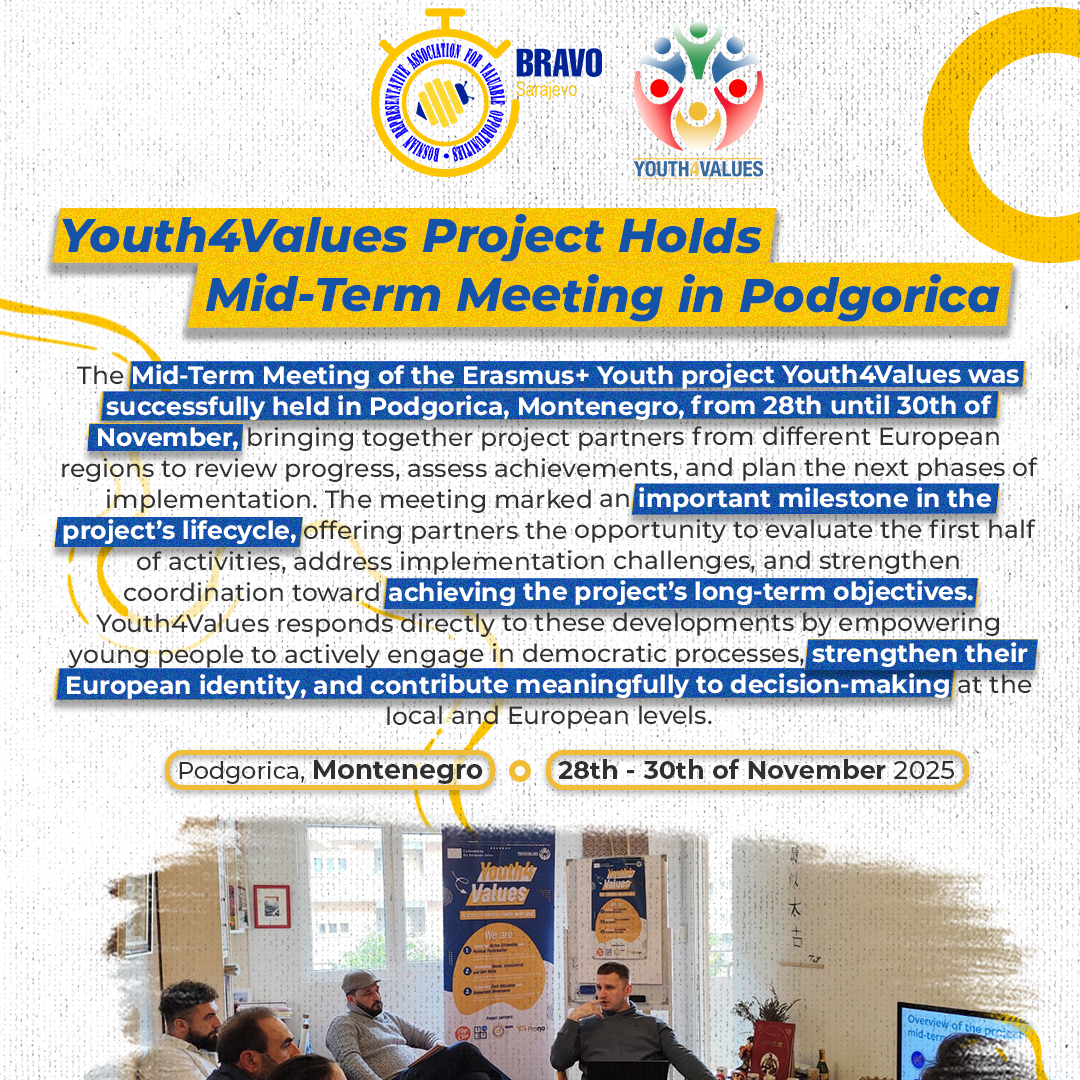
The Mid-Term Meeting of the Erasmus+ Youth project Youth4Values was successfully held in Podgorica, Montenegro, from 28th until 30th of November, bringing together project partners from different European regions to review progress, assess achievements, and plan the next phases of implementation.
The meeting marked an important milestone in the project’s lifecycle, offering partners the opportunity to evaluate the first half of activities, address implementation challenges, and strengthen coordination toward achieving the project’s long-term objectives.
Strengthening Democracy Through Youth Engagement
Youth4Values is a transnational initiative aimed at enhancing democratic governance and the rule of law by fostering a culture of active citizenship among young people. The project supports youth from diverse European regions in developing social, intercultural, and
transversal skills, while encouraging meaningful political participation at the local level.
The project focuses on:
- Promoting civic education,
- Empowering young people with knowledge about their rights and responsibilities, and
- Encouraging policy dialogue, cooperation, and the exchange of best practices across countries
By strengthening the link between democracy and active citizenship, Youth4Values
recognizes that inclusive participation in decision-making processes is essential for resilient and functioning democratic societies, especially at the local level, where young people often feel the least represented.
Review of Progress and Work Package Implementation
During the Mid-Term Meeting, partners reviewed the project’s work package (WP) structure, covering project management, preparation, implementation, impact, dissemination, and sustainability.
Particular emphasis was placed on the successful completion of key deliverables in the first project period, including:
- National Research capturing opinions of young people aged 15–30 and experts in the field,
- Training courses for trainers, youth workers, facilitators, and youth leaders, and
- The implementation of local workshops across partner
Partners presented concrete results from local workshops conducted in Bosnia and Herzegovina, Montenegro, Spain, and Greece, engaging more than 550 young
participants in discussions on civic engagement, EU values, and democratic participation.
Key Activities Ahead: From Awareness to Policy Dialogue
Looking forward, the meeting emphasized several core activities scheduled for the second half of the project. These include:
- Raising Awareness Campaigns focused on media literacy, critical thinking, and responsible digital engagement,
- National Action Plans (NAPs), which will consolidate national-level recommendations into a unified set of policy proposals for EU institutions,
- Community Forums, enabling direct dialogue between citizens, civil society organizations, and decision-makers through simulations of local decision-making processes, and
- The development of a Toolkit compiling lessons learned and practical guidance for sustainable civic engagement.
Additionally, the establishment of a Think Tank and organization of National Dissemination Events will ensure visibility, stakeholder engagement, and long-term impact beyond the project’s duration.
A Shared Commitment to Youth Empowerment and European Values
The Mid-Term Meeting concluded with strong agreement among partners on the project’s relevance in today’s European context, where new forms of participation, such as civic initiatives, community forums, and grassroots advocacy, are increasingly shaping democratic life.
Youth4Values responds directly to these developments by empowering young people to actively engage in democratic processes, strengthen their European identity, and contribute meaningfully to decision-making at the local and European levels.
Through cooperation between youth organizations, educational institutions, and civil society actors, the project aims to bridge existing gaps in non-formal education and create sustainable pathways for youth participation, ensuring that young voices are not only heard, but actively shaping Europe’s democratic future.